DUBAI (Reuters) - A tweet from Arabiya TV quoting the UAE’s foreign minister talking about Iran on Saturday later disappeared from Twitter.
Arabiya TV did not immediately comment on the reason.
The original tweet quoted Sheikh Abdullah Bin Zayed Al Nahyan saying Iran’s fingerprints were clear attacks on oil tankers that took place on May 12.
A statement by the UAE’s state news agency later quoted the foreign minister as saying a state actor was involved but there was insufficient evidence to point to any particular country.
Reporting by Asma Alsharif; Editing by Andrew Heavens
Image caption Mr Zeffirelli directed movie stars including Elizabeth Taylor and opera greats such as Maria Callas
Italian film director Franco Zeffirelli has died aged 96, Italian media report.
The Florence native directed stars including Elizabeth Taylor in the 1967 film Taming of the Shrew and Dame Judi Dench on stage in Romeo and Juliet.
Italian media said Zeffirelli died after a long illness which had grown worse in recent months.
The two-time Oscar nominee also served in the Italian senate for two terms as a member of Silvio Berlusconi's Forza Italia party.
He is perhaps best known to many as the director of the 1968 adaptation of Romeo and Juliet – starring a then-unknown Leonard Whiting and Olivia Hussey.
It was viewed by generations of school students studying the Shakespearean drama.
Image copyright Getty Images
Image caption Franco Zeffirelli, photographed in 1967
The illegitimate son of a merchant, his mother gave him the surname "Zeffiretti" – meaning "little breezes" – which was misspelled on his birth certificate.
The original meaning came from a Mozart opera – and Zeffirelli would go on to become a prolific creator of opera himself, staging more than 120 in his career.
"Franco Zeffirelli, one of the world's greatest men of culture, passed away this morning," tweeted Dario Nardella, mayor of Florence. "Goodbye dear Maestro, Florence will never forget you."
Zeffirelli initially studied architecture, but said that after seeing Laurence Olivier's Henry V (1944), he was inspired to make a career in theatre.
In 1945, he started work as a set designer at Florence's Teatro della Pergola, and concentrated on theatre throughout the 1950s and 1960s.
At the Pope's request, in 1970 Zeffirelli staged "Missa solemnis" in honour of the 200th anniversary of Beethoven's birth.
His first film was a Shakespeare adaptation, of The Taming of the Shrew. While initially intended to star two Italian actors, but was heavily funded by Hollywood couple Richard Burton and Elizabeth Taylor – who eventually assumed the two leading roles.
Another notable adaptation of the bard's plays would come in 1990s Hamlet – starring Mel Gibson in the title role, with Glenn Close and Helena Bonham Carter among the supporting cast.
DUBLIN (Reuters) - Ireland will not allow the Northern Ireland “backstop” clause in Britain’s EU withdrawal agreement to be dropped because doing so would be as big a threat to the country as Britain leaving without a deal, Prime Minister Leo Varadkar said on Saturday.
FILE PHOTO: Ireland's Prime Minister (Taoiseach) and Defence Minister Leo Varadkar arrives for the informal meeting of European Union leaders in Sibiu, Romania, May 9, 2019. REUTERS/Francois Lenoir
While it is “alarming” that leading contenders to replace Theresa May as Britain’s Prime Minister are increasingly threatening a no-deal Brexit, Ireland was 100 percent certain the European Union would not allow the backstop to go, he said.
Leadership contenders, including front-runner Boris Johnson, have called for the controversial Irish clause that is designed to avoid border checks between Ireland and Northern Ireland to be changed or scrapped. They have said Britain would be prepared to leave without a deal if there was no compromise.
“To me no backstop is effectively the same as no-deal because what the backstop is is ... a legally operable guarantee that we will never see a hard border emerge again,” Varadkar told RTE radio. “If we don’t have that, that is no deal.”
How to manage the land border between EU-member Ireland and British-run Northern Ireland - including an emergency “backstop” solution to prevent the return of extensive frontier controls - has proven the most contentious element of Britain’s planned exit from the European Union.
Varadkar again rejected a proposal for a time limit on the Northern Ireland clause, saying a backstop with a time limit is “not a backstop.”
He said that Ireland remained open to the possibility of alternative arrangements that would allow an open border with Northern Ireland while protecting the European Union’s single market - something Johnson has suggested may offer a solution.
But Varadkar said that would only be a possibility once the technologies required had been demonstrated to work effectively.
“What people are saying is give up the backstop, which we know will work legally and operationally in return for something that doesn’t yet exist but might exist in the future ... I can’t do that to the border communities,” Varadkar said.
Varadkar said he was looking forward to sitting down with May’s replacement, but said the next prime minister should not expect a better Brexit deal.
“The fact that the failure of the House Of Commons to ratify the withdrawal agreement somehow means they are going to get a better deal, that is just not how the European Union works,” he said.
Reporting by Conor Humphries; Editing by Edmund Blair
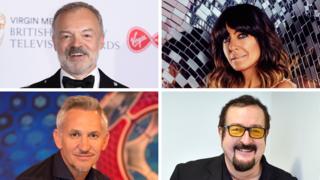
Image caption Graham Norton, Gary Lineker and Steve Wright lead the BBC pay list, with Claudia Winkleman the highest-earning woman
Cutting the pay of stars and senior managers would only save a fraction of the cost of free TV licences for older people, the BBC has said.
The broadcaster has defended its decision to end universal free licences for over-75s because of the £745m cost.
In a letter to the Daily Telegraph, BBC director of policy Clare Sumner said the BBC could only save £25m if it kept all salaries at or below £150,000.
Up to 3.7 million pensioners stand to lose the free licence from next year.
Ms Pearson accused the broadcaster of having a "culture of ludicrously inflated salaries" and being "dangerously out of touch" with the public.
She called for cuts to the salaries of more than 100 senior staff earning over £150,000, as well as cutting the pay of stars and presenters.
According to the BBC annual review last year, among the highest-paid stars were Match of the Day presenter Gary Lineker (£1,750,000-£1,759,999), chat show host Graham Norton (£600,000-£609,000) and Radio 2 presenter Steve Wright (£550,000-£559,999).
The top-earning female star was Claudia Winkleman, whose salary is estimated at £370,000-£379,999.
The total pay for on-air talent was £148m in 2017/2018.
£745mEstimated cost to the BBC of current scheme by 2021/22
£250mEstimated cost of new scheme depending on take-up
190,000people consulted on the change
52%in favour of reforming or abolishing free licence scheme
But in her letter to the Daily Telegraph, Clare Sumner said: "Even if we stopped employing every presenter earning more than £150,000, that would save less than £20m.
"If no senior manager were paid over £150,000 that would save only £5m."
She said spending on senior managers' salaries has been cut by £38m since 2010 and 94% of the BBC's budget was spent directly on programmes and services.
The highest-paid senior manager is director general Tony Hall, with an annual salary of £450,000. In total, 94 executives earn more than £150,000, nine of whom are paid more than £250,000.
'Rising cost'
Providing free TV licences to over-75s who claim pension credit will cost the BBC about £250m by 2021-22, depending on take-up.
But continuing the universal scheme would cost £745m, a fifth of the BBC's budget and equivalent to the cost of BBC Two, BBC Four, the BBC News Channel, the BBC Scotland channel, Radio 5 Live and a number of local radio stations.
"If we had continued with the current scheme, its rising cost would have meant closures of services that we know older audiences, in particular, love, use and value every day," Ms Sumner said.
Free licences were first introduced by the Labour government in 2000.
In 2015, the Conservative government announced the BBC would take over the cost of providing free licences for over-75s by 2020 as part of the fee settlement.
More than 495,000 people have now signed an Age UK petition calling for the government to take back responsibility for funding free TV licences.
Hong Kong Chief Executive Carrie Lam attends a news conference in Hong Kong, China, June 15, 2019. REUTERS/Athit Perawongmetha
LONDON (Reuters) - Britain’s foreign minister Jeremy Hunt welcomed a decision by the Hong Kong government to suspend a proposed law that would allow people to be extradited to mainland China for trial.
Britain returned Hong Kong to Chinese rule in 1997 under a “one country, two systems” principle, with the guarantee of a high degree of autonomy and freedoms not enjoyed elsewhere in China.
“Well done HK Government for heeding concerns of the brave citizens who have stood up for their human rights,” Hunt said on Twitter. “Safeguarding the rights and freedoms in the Sino-British Joint Declaration is the best future for HK and Britain stands behind this legally-binding agreement.”
Reporting By Andrew MacAskill; Editing by Edmund Blair
(Reuters) - - Franco Zeffirelli, the film and opera director acclaimed for movies such as “Romeo and Juliet” and opulent lyrical productions on the world’s major stages, died on Saturday at the age of 96.
Often appreciated more by the public than critics, Zeffirelli was the last of a generation of Italian film giants who came of age after World War Two and included Federico Fellini, Luchino Visconti and Vittorio De Sica.
He directed more than two dozen films, working with stars including Elizabeth Taylor, Richard Burton, Laurence Olivier, Alec Guinness, Faye Dunaway, and Jon Voight.
“Franco Zeffirelli, one of the world’s greatest men of culture, passed away this morning,” Dario Nardella, the mayor of Zeffirelli’s home city of Florence, announced on Twitter. “Goodbye dear Maestro, Florence will never forget you.”
Reporting by Gavin Jones; Editing by Andrew Heavens
HONG KONG (Reuters) - Hong Kong leader Carrie Lam on Saturday indefinitely delayed a proposed law that would have allowed extraditions to mainland China, in a dramatic retreat after anger over the bill triggered the city’s biggest and most violent street protests in decades.
The extradition bill, which would have covered Hong Kong’s seven million residents as well as foreign and Chinese nationals there, was seen by many as a threat to the rule of law in the former British colony.
Around a million people marched through Hong Kong last Sunday to oppose the bill, according to organizers of the protest, the largest in the city since crowds came out against the bloody suppression of pro-democracy demonstrations centered around Beijing’s Tiananmen Square on June 4, 1989.
Demonstrations continued through the week and were met with tear gas, bean bag rounds and rubber bullets from police, plunging the Asian finance hub into turmoil and piling heavy pressure on Lam.
“After repeated internal deliberations over the last two days, I now announce that the government has decided to suspend the legislative amendment exercise, restart our communication with all sectors of society, do more explanation work and listen to different views of society,” Lam told a news conference.
In her first public appearance or comments since Wednesday, she said there was no deadline, effectively suspending the process indefinitely.
Political opponents called for the bill to be scrapped completely. Protest organizers said they would go ahead with another rally on Sunday to demand Lam step down.
The about-face was one of the most significant political turnarounds under public pressure by the Hong Kong government since Britain returned the territory to China in 1997, and it threw into question Lam’s ability to continue to lead the city.
It also potentially alleviated an unwanted headache for the leadership in Beijing, which is grappling with a slowing economy and an all-consuming trade war with the United States.
Asked repeatedly if she would step down, Lam avoided directly answering and appealed to the public to “give us another chance”. She said she had been a civil servant for decades and still had work she wanted to do.
She added that she felt “deep sorrow and regret that the deficiencies in our work and various other factors have stirred up substantial controversies and disputes in society”.
‘GREAT CARE’
The extradition bill deliberations started in February and Lam had pushed to have it passed by July.
But the protests changed the equation. Cracks began to appear on Friday in the support base for the bill with several pro-Beijing politicians and a senior adviser to Lam saying discussion of the bill should be postponed for the time being.
Sing Tao newspaper reported on Saturday that China’s top official overseeing Hong Kong policy, Vice Premier Han Zheng, met Lam in Shenzhen in recent days.
Lam declined to confirm whether or not the meeting had happened, but took ownership for the decision to suspend the bill and said she had support from the central government.
Steve Tsang, a political scientist at SOAS in London, said Beijing had most likely ordered Lam to postpone the bill.
“They would have indicated to Carrie...that this just has to end. She didn’t understand what she was doing,” he said.
“I think Carrie Lam’s days are numbered...Beijing cannot afford to sack her right away, because that would be an indication of weakness.”
The Chinese government office in charge of Hong Kong affairs expressed “support, respect and understanding” of Lam’s decision to suspend the bill.
Hong Kong Chief Executive Carrie Lam speaks at a news conference in Hong Kong, China, June 15, 2019. REUTERS/Athit Perawongmetha
In a statement via the state news agency Xinhua, a spokesman said the central government “fully affirmed” the work of Lam and the Hong Kong government and would continue “to firmly support” her. Beijing “strongly condemns” the violence during the protests and supports the Hong Kong police, the statement said.
Pro-democracy politicians, responding to Lam’s announcement, said a suspension was not enough.
“Carrie Lam has lost all credibility among Hong Kong people. She must step down,” said Claudia Mo, a legislator and member of the pan-democratic camp, which has opposed the bill.
A spokesman said the U.S. consulate in Hong Kong welcomed Lam’s decision and urged “great care and taking into account the views of the local and international community should the Hong Kong government pursue any amendments to its extradition laws, particularly as they relate to mainland China”.
WITHDRAWAL ‘WRONG’
Beyond the public outcry, the extradition bill had spooked some of Hong Kong’s tycoons into starting to move their personal wealth offshore, according to financial advisers, bankers and lawyers familiar with the details.
And senior police officers have said Lam’s refusal to heed public opinion was sowing resentment in the force, which was already battered by accusations of police brutality during the 2014 pro-democracy “Umbrella” civil disobedience movement.
Lam had said the extradition law was necessary to prevent criminals using Hong Kong as a place to hide and that human rights would be protected by the city’s court which would decide on the extraditions on a case-by-case basis.
Critics, including leading lawyers and rights groups, note China’s justice system is controlled by the Communist Party, and say it is marked by torture and forced confessions, arbitrary detention and poor access to lawyers.
China says it respects rule of law.
Hong Kong is governed by China under a “one country, two systems” deal that guarantees it special autonomy, including freedom of assembly, free press and independent judiciary.
Slideshow (6 Images)
Many accuse Beijing of extensive meddling since then, including obstruction of democratic reforms, interference with elections and of being behind the disappearance of five Hong Kong-based booksellers, starting in 2015, who specialized in works critical of Chinese leaders.
The Chinese government has denied that it has overreached in Hong Kong.
Reporting by John Ruwitch, Clare Jim, Jessie Pang, James Pomfret, Joyce Zhou, Vimvam Tong, Anne Marie Roantree, Greg Torode and Twinnie Siu; Writing by John Ruwitch; Editing by Michael Perry and Christian Schmollinger